 í•œêµì–´
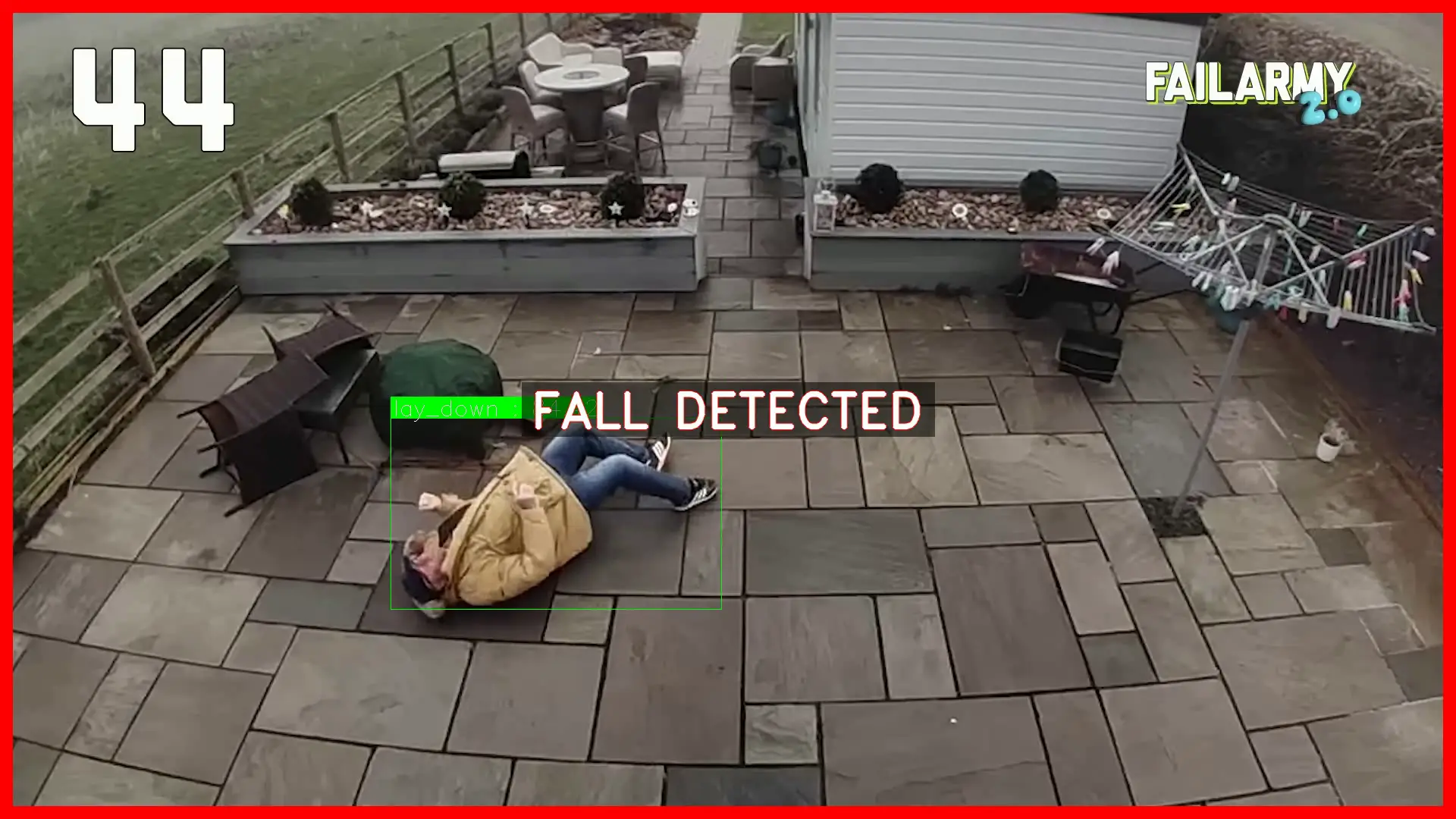
Falls are one of the most critical safety incidents in public and monitored environments. Delayed detection or alarm about it can lead to serious consequences, especially in elderly care facilities, hospitals, and industrial sites. This project has been developed a real-time fall-down detection system for the AXEyes video analytics platform, achieving 89.7% mAP by combining spatio-temporal action recognition with frame-sequence analysis to distinguish genuine fall events from visually similar normal movements, reducing false alerts by 19%.
Spatio-Temporal Detection: Fall events are detected across multiple consecutive frames rather than single images, capturing the motion dynamics that define a genuine fall action and eliminating false positives caused by sudden crouching, sitting, or camera angle changes.
High Accuracy in Real-World Conditions: Achieved 89.7% mAP on a custom-curated surveillance dataset collected from real CCTV footage under varied lighting, camera angles, and occlusion conditions.
19% False Alert Reduction: Post-processing logic filters ambiguous detections using frame-sequence confidence scoring, significantly reducing operator fatigue caused by unnecessary alerts.
Production Deployment: Integrated into the AXEyes VA system monitoring 100+ critical infrastructure CCTV cameras across enterprise and government-level facilities.
Fall-down detection requires understanding motion over time, not just appearance in a single frame. YOWOv3 (You Only Watch Once) combines a 3D CNN for temporal modeling across frame sequences with a 2D CNN for spatial feature extraction per frame. This dual-stream architecture captures both the spatial appearance of a person and the temporal motion pattern of a fall, enabling reliable detection even in complex scenes. The model processes short clips of consecutive frames, learning to distinguish the characteristic trajectory and body dynamics of a fall from superficially similar activities such as sitting, bending, or sudden crouching.
A high-quality custom video dataset was curated from real CCTV footage covering diverse fall scenarios: forward falls, backward falls, side falls, and near-fall motions across different environments including corridors, elderly care rooms, and open areas. Each clip was carefully annotated with temporal boundaries to ensure the model learns precise action onset and completion. The dataset reflects real-world surveillance conditions — variable lighting, mixed camera resolutions, and partial occlusions — ensuring that trained models generalize robustly to the deployment environment rather than overfitting to clean benchmark data.
Single-frame detection of falls is highly unreliable due to visual similarity with normal activities such as sitting, bending, or lying down. The system analyzes sequences of frames and applies confidence aggregation across the temporal window before triggering an alert. Per-frame detection scores are accumulated over the clip and only cross a threshold when the sustained pattern matches a genuine fall trajectory. This approach reduced false event alerts by 19% compared to frame-by-frame inference, directly lowering operator workload in continuous monitoring deployments.
To improve model robustness across real-world surveillance conditions, a custom augmentation pipeline was applied during training. Augmentations include random brightness and contrast variation to simulate day/night CCTV conditions, horizontal flipping for directional invariance, temporal jitter to handle variable frame rates, and partial occlusion simulation to handle cases where a person falls partially out of frame or is briefly obstructed. This strategy was critical for preventing overfitting to a single camera setup and ensuring reliable detection across the 100+ camera network in production.
| Metric | Value |
|---|---|
| mAP | 89.7% |
| False Alert Reduction | 19% |
| Detection Type | Spatio-Temporal (multi-frame) |
| Deployment | AXEyes VA System |
| Monitored Cameras | 100+ critical infrastructure CCTV |